Seventh-Grade Students Discover Local Ties to American Independence
As the nation celebrates the 250th anniversary of American independence, Hommocks seventh graders discovered that history isn’t just found in textbooks. It’s right here in their own community. This milestone provides an opportunity for students to explore our nation’s history, reflect on the importance of civic participation, and connect the past to the present in meaningful ways.
During May, students explored local connections to the Revolutionary era through a walking tour that included the Kemper Memorial, Richbell Cemetery, Harbor Island, the 1816 Schoolhouse, and historic sites along Heathcote Hill and the Boston Post Road. Along the way, they deepened their understanding of the people, events, and stories that helped shape both the nation and the community they call home.
Hommocks Social Studies Department Chair and seventh-grade teacher Andy Scopp organized the trip as a way to help students experience history where it happened.
“Local history matters and kids need to learn more about historical sites they’re walking or biking past, besides just knowing they’re on their way to school,” Scopp said.
Scopp traced the inspiration for the trip to a walking tour about enslavement in the community created by former Mamaroneck High School Original Civic Research & Action (OCRA) students Zoe Stahl and Caitlin Solis. During one of the four days, Zoe, home from college, joined the tour and was excited to see younger students engaging with their work.
“I can’t convey how happy Caitlin and I are to see these young people engaging thoughtfully with our work and carrying on the legacy of our time in OCRA,” she said.
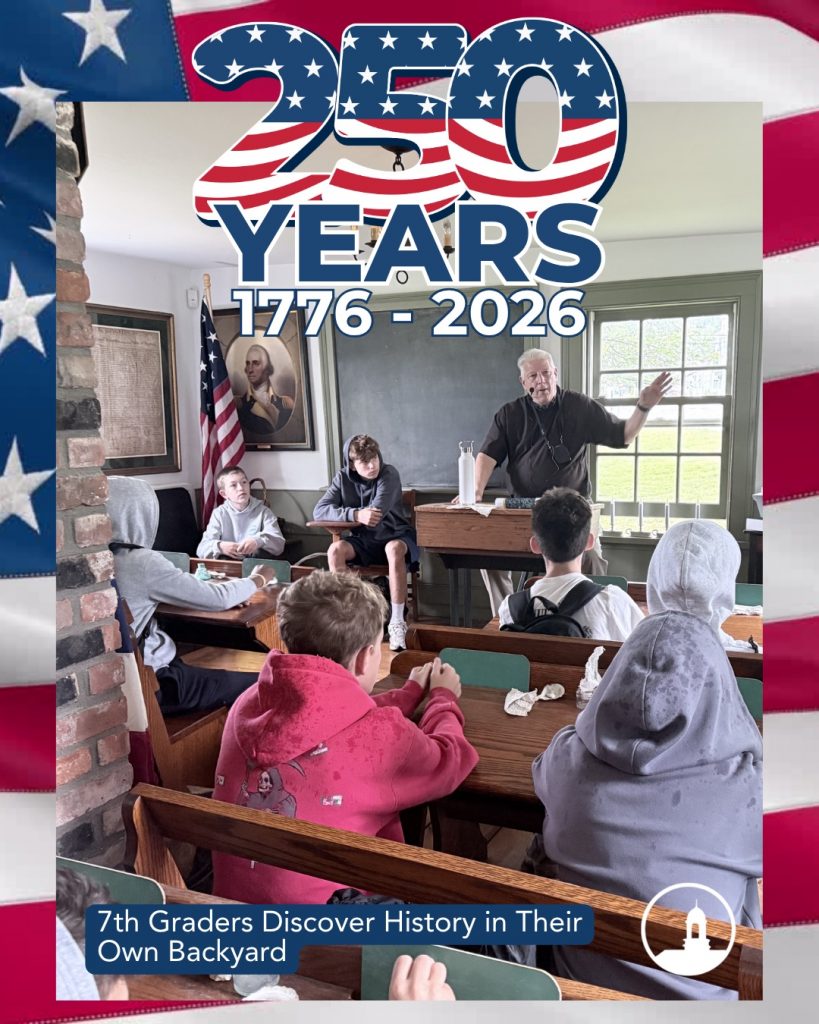
The tour, graciously escorted by the Town and Village of Mamaroneck police departments, continued at Harbor Island and the 1816 Schoolhouse, where students were welcomed by Village of Mamaroneck Historian John Pritts and storyteller Jonathan Kruk, who brought Revolutionary-era Westchester history to life through engaging and immersive storytelling.
Inside the 1816 Schoolhouse, Pritts shared the rich local history of the area. Stepping inside the one-room schoolhouse immediately captured students’ imaginations. For many, it was their first visit. Caleb Boamah reflected, “We got to learn what they learned, what they had to sit in, and what their actual school looked like. I thought that was actually pretty cool.” Sebastian Torres was equally enthusiastic. “I got to ring the bell!”
The historic schoolhouse offered students a tangible connection to the past. “It’s a really amazing historical building,” said Soha O’Keefe. Sebastian pointed out a piece of the original wall still visible inside, a detail that made the building’s history feel especially real.
Outside, Jonathan Kruk transported students back to October 1776, asking them to imagine the sounds of battle – gunshots, screams, and clashing soldiers – all occurring just steps from where they were standing. Through vivid storytelling, he described how British-aligned forces under the command of Robert Rogers raided local farms and villages for supplies, prompting local militia members – ordinary farmers, blacksmiths, and tradespeople – to organize a surprise predawn attack. In the confusion and darkness, combatants struggled to distinguish friend from foe, and some of those captured were neighbors who had chosen different sides in the conflict. Kruk used these stories to help students understand the difficult realities faced by local families, who lived with the constant threat of violence, divided loyalties, and the loss of homes, livestock, and livelihoods during the Revolutionary War. He also shared the surprising story of Yankee Doodle, explaining how a song once used to mock Americans was eventually reclaimed as a source of pride.
To prepare for the experience, seventh grade social studies teachers used a variety of resources, including local historical websites, Kemper Memorial archives, and primary source accounts from Revolutionary War veterans whose writings referenced familiar local places, including Mamaroneck.
Several students reflected on how different the experience felt from learning history in a classroom. Leslie Kravetz noted that reading about battles in books or seeing them in videos is very different from standing in the places where events occurred. Soha agreed.
“When I learned about the battles, I just didn’t fully take it in,” she said. “But when I was there and the people were presenting, I got a better understanding.”
For many students, the Kemper Memorial left the strongest impression. Seeing the names of local residents who served their country helped make history feel personal and relevant.
“It was nice to see all the people who fought for something,” said Soha. “And especially since it was in Mamaroneck, it felt more relatable.”
As communities across the country commemorate America’s 250th anniversary, Hommocks students are learning that history is not only something that happened long ago. It is also a story reflected in the landmarks, people, and places that surround them every day.